- Ⅰ 第1講 Multiplicity
- Ⅰ 第2講 Binary Model System
- Ⅰ 第3講 Sharpness of Multiplicity Function
- Ⅰ 第4講 Most Probable Configuration
- Ⅰ 第5講 Temperature
- Ⅰ 第6講 Entropy
- Ⅰ 第7講 Boltzmann Factor
- Ⅰ 第8講 Partition Function
- Ⅰ 第9講 Helmholtz Free Energy
- Ⅰ 第10講 Sackur-Tetrode Equation
- Ⅰ 第11講 Planck Radiation Law
- Ⅰ 第12講 Electrical Noise
- Ⅰ 第13講 Phonon and Debye Theory
- Ⅰ 第14講 Chemical Potential
- Ⅰ 第15講 Chemical Potential II
- Ⅰ 第16講 Thermodynamic Relations and Identities
- Ⅰ 第17講 Gibbs Sum
- Ⅰ 第二次期中考講解
- Ⅰ 第18講 Quantum Statistics
- Ⅰ 第19講 Fermi and Bose Functions
- Ⅰ 第20講 Ideal Gas in Classical Limit
- Ⅰ 第21講 Thermal Processes for Ideal Gas
- Ⅰ 第22講 Fermi Gas
- Ⅰ 第23講 Metal White Dwarf Star and Nuclear Matter
- Ⅰ 第24講 Bose-Einstein Condensation 1
- Ⅰ 第25講 Bose-Einstein Condensation 2
- Ⅰ 第26講 superfluidity in Helium
- Ⅱ 第1講 heat engine
- Ⅱ 第2講 Carnot cycle
- Ⅱ 第3講 the second law
- Ⅱ 第4講 work in different forms
- Ⅱ 第5講 Gibbs free energy
- Ⅱ 第6講 Clausius–Clapeyron equation
- Ⅱ 第7講 van der Waals equation of state
- Ⅱ 第8講 ferromagnetism
- Ⅱ 第9講 Landau theory of phase transition
- Ⅱ 第10講 第二次期中考
- Ⅱ 第11講 solubility gap in binary mixtures
- Ⅱ 第12講 liquid or solid mixture
- Ⅱ 第13講 Joule-Thomson effect
- Ⅱ 第14講 electrons and holes
- Ⅱ 第15講 n-type and p-type semiconductors
- Ⅱ 第16講 p-n junction
- Ⅱ 第17講 non-equilibrium semiconductors
- Ⅱ 第18講 期中考卷檢討
- Ⅱ 第19講 kinetic theory for ideal gas
- Ⅱ 第20講 Fick’s law for diffusion
- Ⅱ 第21講 law of rarefied gases
- Ⅱ 第22講 Boltzmann transport equation 1
- Ⅱ 第23講 Boltzmann transport equation 2
- Ⅱ 第24講 Einstein relation in Brownian motion
- Ⅱ 第25講 Fokker-Plank equation 1
- Ⅱ 第26講 Fokker-Plank equation 2
- Ⅱ 第27講 Navier-Stokes equation
- Ⅱ 第28講 quantum transport
- Ⅱ 第28講A 豪豬教授慶生影片
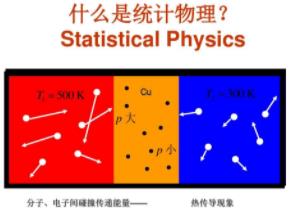
熱力學(xué)與統(tǒng)計物理是研究物質(zhì)熱現(xiàn)象和熱運動規(guī)律理論的物理課程。它是微觀理論研究和宏觀應(yīng)用之間的一座橋梁,前者采用宏觀的研究方法,后者采用微觀的研究方法。兩種方法相輔相成,取長補短。本門課程的學(xué)習(xí)內(nèi)容主要有:熱力學(xué)的基本規(guī)律;均勻物質(zhì)的熱力學(xué)性質(zhì);單元系的相變;多元系的復(fù)相平衡和化學(xué)平衡;;近獨立粒子的最概然分布;玻耳茲曼統(tǒng)計;玻色統(tǒng)計和費米統(tǒng)計;系綜理論;。通過本門課程的學(xué)習(xí),使學(xué)生能夠掌握這兩種研究方法,為今后的進(jìn)一步學(xué)習(xí)與研究打下必要的基礎(chǔ)。